Jackpot Jill Payment Methods
 Available in US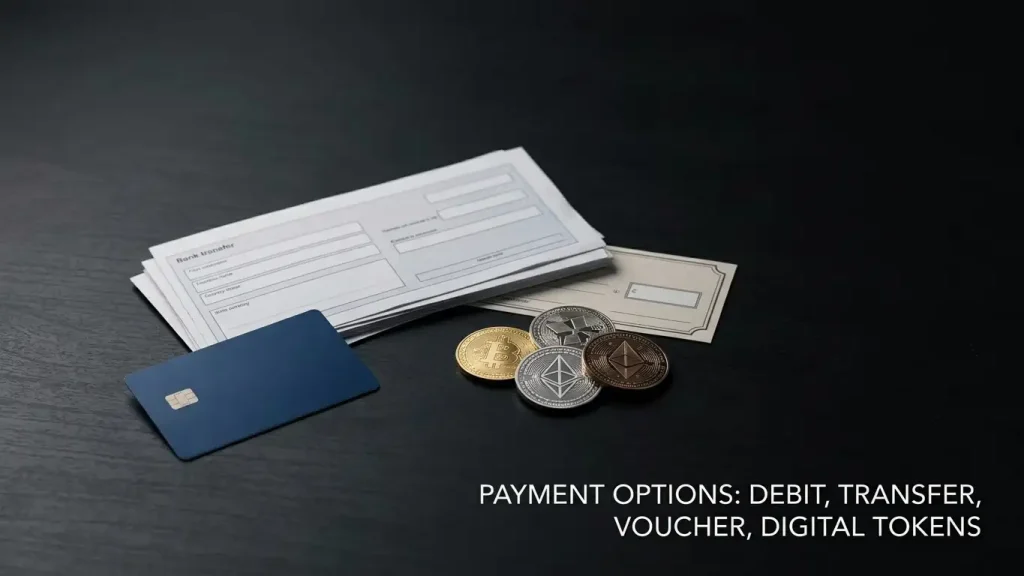
Table of Contents
Section element
Jackpot Jill uses a mixed payment setup with cards, bank transfer, Neosurf and e-wallet-style services alongside five cryptocurrencies: Bitcoin, Bitcoin Cash, Ethereum, Litecoin and Dogecoin. ETH carries the clearest route-specific detail: Ethereum is the named network, the crypto route has its own threshold, and the fee wording refers to blockchain or network charges. BTC, BCH, LTC and DOGE are also available as payment assets, each with its own transfer mechanics.
Deposit routes and minimums
Jackpot Jill gives two deposit figures in different contexts. A mobile-banking page says deposits start from €10. Separately, the ETH page shows a $50 qualifying threshold for the crypto route described there. Those figures should stay attached to their original contexts rather than being merged into one universal cashier minimum.
That distinction matters because the payment list covers several kinds of rail. A card transaction, a voucher payment and a blockchain transfer do not share the same mechanics, currencies or possible costs. Jackpot Jill lists Visa and debit card, Mastercard, bank transfer, Neosurf, eZeeWallet and CashtoCode on the fiat side, and BTC, BCH, ETH, LTC and DOGE on the crypto side.
For withdrawal-specific minimums, route rules and processing claims, the dedicated Jackpot Jill withdrawal guide keeps those details separate from deposits.
- Identify the payment rail first: card, bank, voucher, wallet or crypto.
- Keep the amount in the currency and route context in which it is stated.
- For crypto, check the coin and network together before treating a transfer instruction as complete.
- Use withdrawal information separately because deposit and cash-out limits are not the same field.
Crypto rails and the network detail that matters
Five cryptocurrencies are part of the Jackpot Jill payment mix: Bitcoin (BTC), Bitcoin Cash (BCH), Ethereum (ETH), Litecoin (LTC) and Dogecoin (DOGE). The ETH route uses the Ethereum network. Asset and network selection are separate parts of a transfer instruction, so both need to match the intended destination.
| Coin | Network | Min Dep | Min WD | Speed | Fee |
|---|---|---|---|---|---|
| BTC | — | — | — | — | — |
| BCH | — | — | — | — | — |
| ETH | Ethereum | $50 route threshold | — | — | Network charge framing |
| LTC | — | — | — | — | — |
| DOGE | — | — | — | — | — |
ETH carries route-specific network and cost context, while the other listed cryptocurrencies are shown simply as supported payment assets. That difference matters because an asset name and a transfer network are not interchangeable pieces of information.
If the goal is to understand cash-out limits or pending periods rather than deposit rails, move to the withdrawal page, where those facts are handled in their own context.
Price movement and irreversible transfers
Crypto adds risks that are separate from the casino cashier itself. The value of a coin can move between the time it is acquired, deposited and later withdrawn. Blockchain transactions may also be irreversible, so an incorrect address or network selection can have consequences that a conventional card authorisation does not share.
Network conditions and fees can change as well. Jackpot Jill’s ETH information describes charges as blockchain or network costs rather than presenting them as a fixed casino tariff. That means an example network cost should be treated as a transfer scenario, not as a permanent Jackpot Jill fee quote. The site’s home-page crypto value exposure check follows the same principle by letting the reader enter the price move and network-cost assumptions rather than hard-coding them as brand facts.
- Coin price movement changes the value of a crypto balance independently of casino play.
- Blockchain transfers can be irreversible once sent.
- Network conditions can change the cost of moving funds.
- The selected coin and network should be treated as a pair where the route specifies both.
Account-level identity checks are another separate layer. The account and KYC guide covers the brand’s stated ID and proof-of-address requirements without treating them as payment fees or network mechanics.
Cards, bank transfer, vouchers and wallets
The fiat side of Jackpot Jill is broader than a card-only cashier. Visa and debit card, Mastercard, bank transfer and Neosurf appear both on Jackpot Jill and in Casino Guru’s review. Jackpot Jill also lists eZeeWallet and CashtoCode on its payment and mobile-casino pages.
| Method | Type | Supported context |
|---|---|---|
| Visa / debit card | Card | Listed payment route |
| Mastercard | Card | Listed payment route |
| Bank transfer | Bank | Listed payment route |
| Neosurf | Voucher | Listed payment route |
| eZeeWallet | Wallet service | Listed by the brand |
| CashtoCode | Voucher / cash-code service | Listed by the brand |
The main deposit figure attached to this broader fiat context is the “from €10” statement on the mobile-banking page. It should be read as a general deposit starting point from that page, not copied across every method as if each card, bank or voucher route had the same minimum.
The presence of several rail types also helps separate payment choice from product choice. For game categories, live casino and provider coverage, the games guide handles the casino catalogue without mixing it into cashier mechanics.
Method names tell you less than a route-specific instruction. A card label identifies a payment family, while a crypto transfer needs both an asset and a network context. Jackpot Jill uses Ethereum for the ETH route. The asset, network and destination address together define where that transfer goes.
Network charges versus casino fees
The ETH page describes the relevant cost as a blockchain or network charge. That wording is important because a network fee belongs to the transfer route, while a casino processing fee would be a charge imposed by the operator. The two should not be treated as the same kind of cost.
For practical comparison, the safest way to read the route is to keep three variables distinct: the amount being transferred, any change in the crypto asset’s value, and the network cost of moving it. They affect the value that arrives for different reasons. A larger starting amount does not remove volatility, and a low network cost does not make a blockchain transfer reversible.
Route-specific figures should stay attached to their own context. ETH is paired with Ethereum and Jackpot Jill’s ETH page shows a $50 crypto-route threshold, while a separate mobile-banking page says deposits start from €10. Those figures describe different payment contexts rather than one universal deposit minimum.
For a reader comparing routes, a simple hierarchy helps. First, identify whether the transaction uses fiat or crypto. Second, keep each minimum with the route where it applies. Third, distinguish a blockchain cost from an operator fee. Finally, treat withdrawal conditions as a separate step rather than assuming that a deposit rule also governs cash-out. These distinctions keep payment mechanics, route thresholds and withdrawal rules from being blended into one number.
Payment questions
Which payment methods does Jackpot Jill list?
Jackpot Jill lists Visa and debit card, Mastercard, bank transfer, Neosurf, eZeeWallet, CashtoCode, and the cryptocurrencies BTC, BCH, ETH, LTC and DOGE.
Which network does the ETH route use?
The ETH route uses the Ethereum network. Check the selected asset, network and destination address together before transferring funds.
How should the €10 and $50 deposit figures be read?
They come from different route contexts: a mobile-banking page says deposits start from €10, while the ETH page shows a $50 qualifying threshold for the crypto route described there.
Jackpot Jill’s payment mix is broad, with the clearest route detail on ETH
Jackpot Jill combines conventional rails—cards, bank transfer, Neosurf and wallet-style services—with BTC, BCH, ETH, LTC and DOGE. The strongest route-level detail sits with ETH: Ethereum is the named network, the ETH page gives a $50 crypto-route threshold, and its fee wording points to blockchain or network charges. A separate mobile-banking page says deposits start from €10. Those figures belong to different contexts, so the useful reading is a mixed cashier with both fiat and crypto access, not one universal minimum or fee schedule. Detailed cash-out limits and timing are covered separately on the withdrawal page.