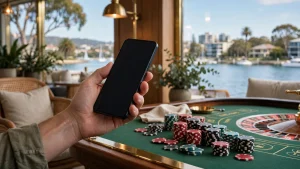
A game name alone cannot confirm whether a demo, cash play or a particular operator is available to Australian players.

In Australia, talk about casino games sits beside a much bigger, older conversation about pokies: how much people lose, where that money goes, and whether the rules should change. A new game name can draw attention, but it does not arrive in a vacuum. For many of us, the word “casino” already carries the weight of poker machines in clubs, hotels and pubs, and of arguments that have been running for years.
I have made the mistake of treating a game’s name as if it tells me what the experience will be. It doesn’t. Nor does curiosity about a new title erase what we know about the wider costs of gambling. The Australian debate is not simply about whether a machine is entertaining. It is also about losses at a community level and the harm gambling can cause, particularly to people who are vulnerable.
One report by gamble.com.au put Victorian poker-machine losses at $2.6 billion over a year, more than $44.7 million above the figure it cited for 2015. Those numbers belong to a reported period, not to some timeless measure of what happens every year. Still, they help explain why pokies remain a political subject rather than just another feature of a night out. The sums are large enough to prompt questions about who pays, who benefits, and what safeguards are meant to do.
If you’re looking for a Mines casino game in Australia in 2026, licensing and practical details can help you assess where to play. Use these concise operator notes as a starting point and check the terms that matter to you.
Golden Pokies
Golden Pokies lists a Curacao licence. You can use that as one licensing detail to consider when assessing the operator.
Rollero Casino
Rollero Casino lists a Curacao Gaming Control Board licence, OGL/2023/176/0095, held by Hollycorn N.V. You can refer to those details when checking its licensing information.
Uptown Pokies
Uptown Pokies has operated since 2017 and lists a minimum deposit of A$20. You can weigh its stated operating history and entry amount when considering it.
SkyCrown
SkyCrown lists a Tobique Gaming Commission licence and a minimum deposit of A$30. If payout timing matters to you, its stated estimates are around 10–15 minutes for crypto and 1–5 days for fiat.
Thor Casino
Thor Casino lists a Curacao licence through Antillephone N.V. for Versus Odds B.V. Its stated minimum deposit is EUR 20, which you can factor into your choice.
SpinsUp
SpinsUp lists a Curacao Gaming Control Board licence, OGL/2023/174/0082, held by Dama N.V. You can use those licensing details as a starting point for your checks.
7Bit Casino
7Bit Casino is listed as a Curacao operator run by Dama N.V. You can consider those details when checking the operator.
Roby Casino
Roby Casino lists a Curacao eGaming licence through Roby Games Ltd. You can use the named licence and company as reference points when assessing it.
Lucky Dreams
Lucky Dreams lists a Curacao licence and a minimum POLi deposit of A$20. You can consider that payment method and entry amount when deciding whether it suits you.
House of Pokies
House of Pokies lists an international iGaming licence, though the jurisdiction is not named in the available information. Its stated PayID payout timing is 1–24 hours, and the minimum deposit is A$30, or A$10 when using PayID.
The same report highlighted the Epping Plaza Hotel in Melbourne’s north, saying its 100 machines generated more than $21 million over the year it covered. That is a venue-specific figure, not a description of every hotel or club. But it makes the scale easier to picture: a familiar local setting, a fixed bank of machines, and a substantial amount of money attached to their use. I find that harder to shrug off than a slogan about “big wins”. The wider picture matters.
Reform proposals have followed those concerns. Senator Nick Xenophon and MP Andrew Wilkie, for instance, put forward a plan to cap poker-machine bets at $1. That was a proposal, not a rule that can be assumed to have taken effect. The distinction matters: public debate often turns a suggested measure into something that sounds settled, especially when people repeat it without its history. The proposal itself shows what reformers were trying to address—how quickly losses can accumulate when bets are high and play continues.
That argument is not only about one cap. It reflects a recurring tension between personal choice and the design of gambling environments. Supporters of tighter controls may focus on reducing exposure to harm; opponents may object to restrictions on adult decisions or on venues that depend on gambling revenue. I’m not going to pretend there is a neat answer in a slogan. What is clear is that a discussion of pokies in Australia has real people and real consequences behind it.
That is why I’m wary when a gambling product is described as “just a bit of fun”. The phrase can make the stakes sound small even when a person is losing more than they intended, or when gambling is causing serious harm in their life. A game’s label does not tell you whether it is harmless for a particular person. Nor does a polished presentation make the broader debate disappear.
The language people use around these games can blur important differences, too. Poker machines are often called pokies here, while the formal term EGM may appear in reporting and policy material. Those words point to a recognisable part of Australian life, but the conversation around them is not merely about terminology. It is about losses, access, regulation and the effect gambling can have on households and communities.
So when a new casino title catches your eye, it is worth keeping that local context in view without treating it as a recommendation or an invitation. Interest in a game is one thing; the Australian discussion of poker machines is another, and it has been shaped by reported losses and reform proposals, not by advertising language. I’ve learned that the hard way: a catchy name can make something feel separate from the usual debate, even when the concerns around gambling still apply.
No easy reset.
“Mines casino” sounds specific at first glance. It is not. The words tell you the subject is associated with a casino-style game called Mines, but they do not identify who made it, which version someone means, or what a particular website is offering. I used to treat a familiar label as if it were a product name. That shortcut is an easy way to assume more than the words actually establish.
“Mines” can function as a game title or category label across different pages. Add “casino” and you still have a broad description, not a reliable fingerprint. A page headed “Mines Casino Game” might be discussing a particular product, using a generic label, or referring to a game available through another service. The wording alone cannot settle which interpretation is right.
That distinction matters because online descriptions can make separate things blur together. A game, its developer, a website that lists it and a business operating that website are not interchangeable. The same title on two pages does not prove the pages refer to the same release or provider. Nor does a polished logo establish who created the game. Branding is a signpost, not proof. I learned to slow down there.
The year in a phrase such as “Mines casino game Australia 2026” does not fix that uncertainty. A date can indicate when someone wants current information, but it does not verify that a game has been updated, that a feature is available, or that an operator is connected to it. Those are separate claims. If a page makes them, they need to be checked on their own rather than inferred from the heading.
The same goes for labels like “new,” “popular” or “official.” They may be descriptive marketing language, not evidence. “Official” should prompt a basic question: official according to whom, and what relationship is being claimed? A site might host a page about a title without being its maker. A product name might appear beside a provider’s name without making every similarly labelled version the same product. The words do not do the paperwork.
I would also separate the game’s identity from its presentation. A page may show a name, images, a short description and buttons or menus. Those details can tell you what that page is claiming to offer, but they do not independently verify the developer or the operator behind it. If those distinctions matter to you, look for clear attribution and consistent information rather than relying on a headline or a familiar-looking graphic.
There is a useful way to read the phrase without making it carry too much weight: it points to interest in a casino-style title or category called Mines. That is enough to understand the subject. It is not enough to infer a single standard version, a fixed feature set, or one company behind every result. I would not assume that two pages with similar wording share the same game simply because the name matches.
This is especially worth remembering when a page moves quickly from a broad title to confident claims. A product name may be repeated in headings, menus and promotional copy until it feels verified by sheer repetition. It isn’t. Check whether the page clearly names the provider and explains what it means by Mines. If it does not, keep the identity unresolved rather than filling the gap with a guess.
I’m not saying every label is misleading. I’m saying a label has a limited job. It can help you recognise the topic, but it cannot establish the details around it. “Mines casino” identifies a subject area; by itself, it does not certify a particular release, feature list, provider or operator. Plain distinction. That’s it.
And whatever version someone may mean, the name does not turn gambling into a dependable way to make money. Pokies and other gambling products can cause serious harm, particularly for vulnerable people. Recognising what a title does—and does not—tell you is a small step, not a recommendation to play.
When I look at an online casino page that mentions Mines, I separate two things that are easy to blur together: what the site offers and what Australian law permits it to offer here. A page may load, show prices in Australian dollars or display familiar payment options. None of that, by itself, means the service is authorised to provide real-money online casino games to people in Australia.
The relevant law is the Interactive Gambling Act 2001. It restricts operators from offering online casino services to people physically located in Australia. That covers casino-style games provided for real money, rather than only a particular title or format. Calling something a Mines game, a casual game or a crash-style extra does not settle its legal status. The important question is what service is being offered and to whom.
That distinction matters because offshore sites can be visible to Australians while operating under licences issued elsewhere. Some accept Australian payments, but a payment option is not an Australian licence, a local regulator’s approval or proof that the service complies with Australian law. I used to treat familiar currency and a polished page as reassuring signals. They are not. A website can look tailored to Australian visitors without having permission to provide online casino services here.
The legal restriction is directed at providers. The position of an individual player is different: Australian players are not criminalised simply for using an offshore gambling site. It is worth stating that plainly, without turning it into an endorsement. The fact that a player is not criminalised does not make the operator’s offer lawful in Australia, guarantee that the site is safe, or give the player the protections they might expect from a locally authorised service. Those are separate questions.
So if you are trying to understand whether an online Mines casino is “available” in Australia, availability can mean several different things. A page might appear in a browser; it might accept an Australian payment; or it might legally be offered to someone in Australia. The first two do not prove the third. That small distinction is where a lot of confident-looking advertising gets slippery.
I also wouldn’t read an offshore licence as though it were an Australian one. It may describe the operator’s status under another jurisdiction’s rules, but it does not override the Australian restrictions. And a site’s own claim that it welcomes Australian customers is still a claim made by the site. It is not independent confirmation that the offer is permitted here.
This is not a technicality about one game name. The same legal frame applies whether a page calls the product Mines, an online casino game or something else. Nor does a phrase such as “cheat” change the underlying issue: a search for a shortcut or tool does not establish that a particular game exists, that a claim is genuine, or that the service offering it is lawful for Australians. I would be wary of any page that uses those words to rush you toward registering or paying.
Legal Warning
Under the Interactive Gambling Act 2001, it is prohibited for operators to provide real-money online casino services to people physically located in Australia.
There is a practical side to the legal distinction, too. If a dispute arises with an offshore operator, do not assume that the protections and complaint routes familiar from Australian services will apply in the same way. The operator may be governed by rules elsewhere, and its own terms may describe the relationship in a way that is difficult to challenge from here. Reading a licence badge or a payment logo as a promise of local recourse is a mistake I would not repeat.
If you are under eighteen, do not gamble. For adults, the lack of criminal liability for a player should not be confused with a risk-free choice: gambling can cause serious harm, particularly for people who are vulnerable or already struggling to control it. I have learned to distrust the reassuring word “legal” when it is used without saying whose conduct the law is addressing. Here, the provider’s restriction and the player’s position are not the same thing. That is the key point.
When someone asks for a free way to try Mines, “free” can mean a few different things. It might mean a page that lets you interact with a game without staking money. It might mean a playable-looking screen that is only a preview. Or it might be a label attached to a page that eventually asks you to deposit. Those are not the same offer, and the word alone does not tell you which one you have found.
I used to treat a bright “free” label as the answer. It wasn’t. The useful question is whether anything of value is being staked, whether the session can pay out anything, and whether the page moves you toward a cash account. If the page is unclear on those basics, the label has done its job for the page, not for you.
A no-stake experience, if one is actually available, is separate from real-money gambling. It does not establish that the same game is offered for cash, that the play behaves the same way, or that a cash version is lawful to provide in Australia. A free-looking screen can tell you little about what happens outside that screen. It is not a shortcut to treating an online casino as a harmless or approved option.
That distinction matters here. Under Australia’s Interactive Gambling Act 2001, operators cannot provide real-money online casino games to people in Australia. Calling a page “practice,” “social” or “free” does not by itself settle what the service is doing. I’d look at the actual terms and the steps the page asks you to take, rather than trusting a friendly label. If it asks for a deposit, ties access to a cash balance, or describes withdrawals, that is no longer just a free-play question.
There is also a difference between trying something and learning something reliable about it. A free session may not reflect the conditions of a cash game, and it does not prove that a particular Mines title has a demo mode. I wouldn’t infer a specific feature from a generic “play free” button. The name on the page may be broad, and the screen may be a preview or something else entirely. Labels are cheap.
“Fake casino” can mean different things to different people. Sometimes it means a pretend environment with no money involved; sometimes it means a page that imitates a casino interface or uses casino language to draw people in. The phrase itself is not a guarantee of safety, authenticity or harmlessness. Don’t enter payment details or personal information just because a page presents itself as a simulation. If you cannot tell who operates it or what the interaction involves, stepping away is a sensible choice.
Free access can still have a cost in attention, pressure or personal data. A page might ask you to register, accept tracking, or follow links elsewhere. Read what is being requested before you proceed. If the offer is genuinely no-stake, it should be possible to understand that without being hurried into a deposit or account decision. I’ve learned not to confuse “nothing paid at the start” with “nothing at stake.” Small distinction. Big one.
And free does not mean risk-free for everyone. Gambling content can be difficult for people vulnerable to gambling harm, even when a page is presented as practice. Anyone gambling must be at least eighteen, but age alone does not make an experience suitable. If you know that casino-style play pulls you toward spending, skipping it is a better boundary than testing your control.
So, a free Mines experience should be understood only as whatever the page demonstrably offers without a cash stake—not as evidence that a real-money version is available, appropriate or legal to provide in Australia. Don’t let one word do more work than it can.
A page can put “demo” in its title without actually offering a playable demonstration. I’ve learned to treat the label as a claim to check, not proof. Sometimes it leads to a description, a review, or a page about a different game with a similar name. The word alone tells you very little.
Start with what the page says the demo is. Does it identify the specific Mines game and show a game screen, or does it stay vague about the provider and version? The name “Mines” is not enough to establish that two pages refer to the same title. If the page does not clearly identify what it is presenting, you cannot reliably tell what the demonstration represents.
Then look for an actual demo interface. A screenshot or promotional image is not the same thing as a working demonstration. A page may describe a demo, display a launch button, or send you elsewhere without making clear what happens next. Before proceeding, check whether the page explains where that button leads and whether the demonstration is available without creating an account or making a payment. If those details are missing, don’t fill in the blanks yourself.
The limits matter, too. A demonstration may not reflect every feature, setting or outcome of another version of a game. Read the accompanying notes rather than assuming that a demo label means a complete, identical copy. If the page gives no explanation of what is included, that is a real gap—not a reason to trust the label more.
I also check whether the page distinguishes a demonstration from a real-money service. Blurred wording can make a page seem purely informational while steering you towards something else. For readers in Australia, that distinction is especially important: real-money online casino games are prohibited services when offered to people here. A demo label does not change the nature of a separate cash-play offer.
So, when a page claims to offer a Mines demo, verify the game’s identity, the presence of an actual demonstration, what the launch process involves and what the demo does not represent. If the page cannot answer those basics plainly, treat the claim as unverified. Labels are cheap. Clarity isn’t.
A Mines bonus code can sound like a simple extra: enter a phrase, receive funds. I used to stop reading at the headline. That was the mistake. A code’s wording does not tell you whether it is valid, what it applies to, or whether any bonus is available to you. “No deposit” describes a claimed offer condition, not money you can assume will be credited or withdrawn.
Bonus funds are not cash. If an offer attaches conditions, winnings derived from those funds may be held until the wagering requirement is met, and the terms may restrict which games count. Specialist reviews describe requirements in the 30–50x range, but that is not a universal rule; the offer’s own terms would need to state what applies. The multiplier, the amount it applies to and the eligible games all matter.
The arithmetic can make a headline look very different. One specialist review describes a $100 bonus with a 40x wagering requirement: that means $4,000 in bets before bonus-derived winnings can be withdrawn. That example illustrates how the calculation works; it is not a promise that any particular Mines offer uses those terms. And the total bet figure is not a target to chase. It is a condition that may make an offer less useful than it first appears.
Game weighting can add another layer. A specialist review has described blackjack as contributing only 10% toward wagering requirements. That is an example of how terms may count different games unequally, not a general rule for every offer or game. If a condition is unclear, don’t assume that every wager advances it at the same rate.
Before treating a code as meaningful, read the full terms for eligibility, expiry, maximum withdrawal, excluded games and any restrictions on cashing out. Check whether the requirement applies to the bonus alone or to a combined amount, and whether the code changes the terms shown elsewhere. The headline can leave out the costly part.
A code appearing in a message or on a page is not evidence that it works, that it is current, or that the offer is suitable for Australian readers. I now treat “free” as a label to verify, not a benefit to count. Small print matters.
A balance on a screen and money in your account are two different things. I learned to treat “instant cashout” as a claim to inspect, not a promise. A withdrawal can sit in a pending queue, wait for checks, then take additional time to move through the payment method. The displayed processing time may describe only one part of that chain.
Read the payment terms before relying on a stated timeframe. A specialist review describes BPAY transfers as potentially taking a bank day; that is an account of one service, not a universal schedule. The same caution applies to crypto: one specialist review says those withdrawals can clear fastest, but network fees and conversion spreads may cut what arrives. Speed is only one part of the cost.
The minimum withdrawal matters too. Offshore sites commonly set thresholds in the A$75–A$150 range, so a smaller balance may not be payable yet. Check whether the threshold applies to each payment method, and whether the amount shown is before or after fees. Small print can make a nominal balance less useful than it looks.
First cashouts can bring KYC checks. You may be asked for a passport or driver’s licence and a utility bill, and a mismatch between account details and documents can slow the process. I used to think verification was a box to tick at the end. Bad assumption. It can be part of the withdrawal itself.
For anyone considering real-money Mines play, the practical details do not change the legal setting: Australian law prohibits operators from providing real-money online casino games to people in Australia. This is not a recommendation to use an offshore service. If you are assessing a payment claim, look for the exact withdrawal threshold, fees, processing stages and document requirements in the terms—and remember that a displayed balance is not a confirmed payout.
When I’m trying to work out what a page actually offers, I don’t treat a working link as proof that it is meant for Australians or that it will stay reachable. A page about a Mines-style casino game can lead into prohibited online gambling services, and a familiar name or polished layout does not change the rules.
The regulator to understand here is the Australian Communications and Media Authority, or ACMA. It oversees compliance with federal interactive gambling laws and enforces the Interactive Gambling Act 2001. That law bars operators from providing real-money online casino games to people in Australia. So a request to find somewhere to play is not the same as a recommendation that Australians should use a particular site. I won’t point you to offshore services.
ACMA can ask Australian internet providers to block websites that supply prohibited interactive gambling services or advertise them to people here. A block is an access measure, not an endorsement of another site, and it does not tell you that a page is safe just because it remains visible. Links can disappear, and names can be reused. “Still online” is a weak test. That one fooled me before.
ACMA says enforcement actions have led to more than 1,455 illegal gambling and affiliate websites being blocked since November 2019. The reported count of illegal services that have left Australia since enforcement began in 2017 is less settled: one figure puts it above 210, while another says more than 190. Those are different reported totals, not a reason to pick whichever sounds more impressive.
That matters when you see a label such as “Lucky Mines” attached to a page, or try to establish where an online Mines game can be accessed. A name does not reveal who operates the page, what service it provides, or whether ACMA has taken action against it. Nor does a search result amount to regulatory approval.
I’ve learned not to read availability as permission. ACMA’s blocking role is part of how Australia enforces its online gambling rules; it is not a directory of places to play. If a page vanishes or a new one appears under a similar name, that alone settles very little.
A confident-sounding Mines strategy can make a guess look like a system. I’ve been taken in by that kind of wording before: a tidy sequence, a promised edge, and no clear explanation of what the claim is based on. The label is easy to write. Evidence is harder.
That matters with Mines because the name alone does not identify one confirmed set of rules or features. A strategy that depends on particular settings, outcomes or payout rules cannot be treated as universal when the specific game has not been established. Even a detailed set of instructions may describe one version, not every game that uses the Mines name.
The Spribe wording needs the same care. Seeing Spribe attached to a Mines-related description does not, by itself, verify that a particular game is made by that provider, or that a strategy discussed alongside the name applies to it. I would look for the game’s actual provider and rules, then check whether the strategy’s claims match those details. If the page offers no basis for its claims, the confident tone is not a substitute.
Be wary of language such as “safe pattern” or “guaranteed method”. Those are sales-like labels, not proof that a sequence can control uncertain results. A strategy might describe how someone chooses to approach a game; that is different from demonstrating that the approach changes its underlying odds or prevents losses. Don’t let a neat explanation blur that distinction.
I now treat strategy claims as claims to inspect, not instructions to follow. Who is making the claim? Does it identify the specific game and explain the basis for the method? Does it admit what the method cannot establish? If those points are missing, I don’t fill the gaps with optimism.
No magic pattern. A claim still needs evidence.
When I see a brand name paired with “Mines”, I read it as a request to connect the two: perhaps the person wants a review, a rating, or a page about a particular game. But the wording itself proves none of that. It could just as easily be an incomplete search, a comparison someone is trying to make, or a name copied from somewhere without enough context.
That distinction matters. A page mentioning Casino Guru and Mines is not automatically a review of a specific Mines game. Nor does the pairing establish that the brand made, operates or endorses the game. Similar names can point to different products, and a short label can hide important differences.
I’d check what the page actually identifies before treating its claims as relevant. Does it give the game’s full title and name its provider? Is the rating clearly attached to that exact game, rather than to a casino or a broader category? Does the page explain what the rating measures, and when the information was last checked? Those details help separate a genuine, specific assessment from a loose mention.
“Reviewed” sounds definitive; it may only mean a page has been published. A score without a clear subject or explanation doesn’t tell me much. Neither does a logo or brand name placed beside a game title.
So if you came across a Casino Guru reference while looking into Mines, treat the connection as something to verify, not a conclusion. Read the page’s own wording and see exactly what it names. A familiar label can be useful for finding context, but it is not evidence on its own. I’d rather leave the connection open than assume a review, rating or endorsement that the page does not clearly establish.