A practical look at browser and PWA access, Australian rules, payment options, bonus terms and checks before real-money play.
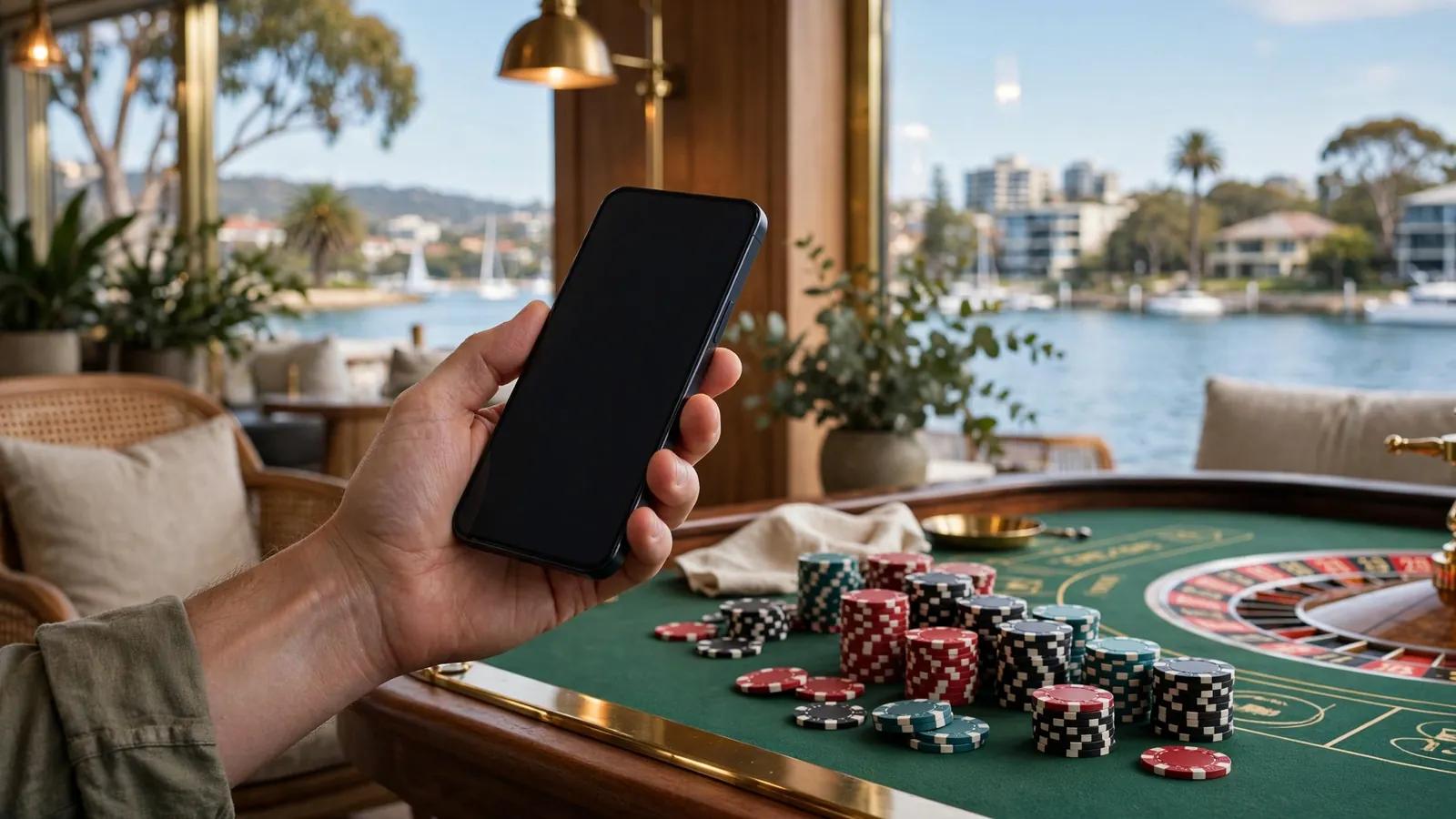
The first thing I’d check is whether the site opens properly in your phone’s browser. For Australian visitors, browser access is the usual route: many offshore crypto-friendly casinos that accept Australians provide a mobile website or a Progressive Web App (PWA), rather than a native app. That means you can often use the same account you use on a desktop without adding another app to your phone.
I used to think “mobile casino” meant downloading something. It doesn’t have to. Open the site in your browser and, if it supports mobile access, you can use its pages there. There is no separate app to find first. That matters in Australia, where casino apps are seldom available through Google Play or Apple’s App Store. Browser play is the practical default, not a workaround you should assume will suit every site.
A mobile website is still a website. A PWA is a shortcut to that website, set up to behave more like a native app on your device. If the site offers one, you may see an install or add-to-home-screen prompt. Tap it, confirm the installation, and the shortcut is added to the phone. The exact prompt can differ by device and browser, so don’t assume you have missed a step if the wording is different.
Choosing a mobile casino in Australia means weighing the details that matter to you, such as licensing, deposit options and payout timing. Use these brief operator notes as a starting point for deciding which options to explore further.
Golden Pokies
Golden Pokies is listed with a Curacao licence. You can use that licensing detail as one point of reference when considering it.
Rollero Casino
Rollero Casino holds a Curacao Gaming Control Board licence, OGL/2023/176/0095, under Hollycorn N.V. You can refer to those details when assessing its licensing.
Uptown Pokies
Uptown Pokies has operated since 2017 and lists a Curacao licence. Its stated minimum deposit is A$20.
SkyCrown
SkyCrown is licensed by the Tobique Gaming Commission. Its stated payout timing is around 10–15 minutes for crypto and 1–5 days for fiat; the minimum deposit is A$30.
Thor Casino
Thor Casino lists a Curacao licence from Antillephone N.V. for Versus Odds B.V. Its stated minimum deposit is EUR 20.
SpinsUp
SpinsUp holds a Curacao Gaming Control Board licence, OGL/2023/174/0082, under Dama N.V. You can use this information as a reference when reviewing the operator.
7Bit Casino
7Bit Casino is licensed in Curacao and operated by Dama N.V. Those are the licensing and operator details provided for this option.
Roby Casino
Roby Casino is listed with a Curacao eGaming licence held by Roby Games Ltd. You can consider this detail as part of your review.
Lucky Dreams
Lucky Dreams lists a Curacao licence and a minimum deposit of A$20 via POLi. That gives you a stated deposit option to consider.
House of Pokies
House of Pokies lists an international iGaming licence, though its jurisdiction is not named in the source. PayID payouts are stated as taking 1–24 hours, and the minimum deposit is A$30, or A$10 with PayID.
After that, opening the shortcut takes you to the site in a more app-like way. It is not the same thing as installing a conventional app from an app store: the PWA remains connected to the casino website. It can make the site easier to return to, but it does not turn the operator into a different service or provide a separate account. You still sign in to the same account you would use in a mobile browser or on a desktop.
That distinction is useful when a page describes itself as an “app”. The word can mean a downloadable native app, or it can mean a website shortcut. I’d look at what the site is actually asking you to install before tapping anything. If it is a PWA prompt on the casino’s website, the result is a home-screen shortcut. If you are being asked to download an app file from outside an official store, that is sideloading, and its security risk depends on the operator. I would not treat an app’s polished appearance as proof that it is safe.
There is also a basic question before any setup: does the site accept people in your location? Confirm that directly with the operator before depositing. A site being visible in a browser, or offering an Australian-facing page, does not by itself confirm that it accepts your location. Offshore access can be blocked by the Australian Communications and Media Authority (ACMA), and using a VPN to get around a block may lead to winnings being voided or an account being closed. There is no Australian government body to complain to if an offshore casino refuses to pay winnings.
That is a lot to check before adding a shortcut. Fair enough. Don’t let the convenience of an icon make the decision for you.
For setup, the browser-first route is straightforward: visit the casino website using your phone, sign in with the same account used on desktop, and see whether the pages are usable as they are. If the site offers a PWA prompt and you want a home-screen shortcut, use that prompt and confirm. If it does not, you can keep using the browser; an app is not required just because the site is being viewed on a phone.
I’d avoid searching for a separate casino download simply because an app-store listing is absent. In Australia, those listings are uncommon for casino apps, so their absence is not unusual. A browser page or a PWA may be the access option instead. If the operator pushes a sideloaded app, pause and consider the security risk rather than assuming that installing it is necessary.
My preference is to start in the browser and only add a PWA shortcut if it genuinely makes returning to the website easier. A shortcut is convenience, not a quality mark. And whether you use a browser or a PWA, confirm location acceptance before depositing; neither setup changes the operator’s terms or removes the risks of dealing with an offshore service.
Once a casino page is open on your phone, the main problem may have nothing to do with the game itself. A screen that freezes, a button that does not respond, or a session that drops out can make a simple task feel like a technical puzzle. I used to blame the site first. Sometimes that was fair; sometimes the phone was struggling.
A specialist review identifies poor internet connection, limited device memory, an outdated browser and too many background apps as common causes of mobile casino problems. Those issues can overlap, which makes guessing less useful than checking one thing at a time.
A weak or interrupted connection can leave a game loading, delay a response or break the session. If the page behaves differently as you move between locations, the signal may be part of the problem. A brief loss of connection can also make it hard to tell whether a tap registered, so repeatedly pressing the same control may not help.
I try to notice whether other pages are also slow before deciding the casino page is at fault. If everything is struggling, refreshing the game over and over is unlikely to fix the underlying connection. If other pages work normally but one game does not, the cause may be elsewhere.
The frustrating bit is that a connection can look fine and still falter. A page that eventually appears is not necessarily working smoothly.
Low memory can affect how a mobile page runs, especially when several things are open at once. Background apps take up resources too. If a game becomes sluggish while other apps are active, closing what you do not need and trying again may help identify whether the phone is overloaded.
That is a troubleshooting step, not a promise. If the device is older or already busy, a demanding page may remain slow even after you close other apps. I have wasted time tapping at a frozen screen when the sensible move was simply to stop and let the phone recover.
A small screen adds its own practical friction. Controls can feel crowded, and it is easier to touch the wrong area when you are trying to work around a lagging page. When the screen has not caught up, pause before tapping again. It is a small habit, but it can prevent a muddle.
An outdated browser can cause problems with pages that rely on newer features. If a mobile game behaves strangely, checking whether the browser needs an update is a reasonable next step. A browser that has not been updated may also make it harder to distinguish a site problem from a device problem.
I would not assume every glitch means the whole site is broken. Nor would I assume an update will solve everything. The useful approach is to change one thing, then see whether the behaviour changes. If you change the connection, close apps and restart the page all at once, you will not know which step mattered.
If the page repeatedly freezes or disconnects, avoid continuing through a session you cannot reliably control. Note what happens: does it fail while loading, after the screen has been idle, or when the phone is busy with other apps? That pattern can help you explain the issue if you contact the site’s support team.
Troubleshooting Glitches
Check the connection
Observe if other pages are slow to determine if the internet signal is the cause.
Manage device memory
Close unnecessary background apps to see if the phone is overloaded.
Update the browser
Ensure your mobile browser is current to support newer page features.
Identify failure patterns
Note if the game fails during loading or while idle to provide details to support.
Do not keep refreshing without checking what the page is doing. A reload may interrupt a session, and a delayed screen can leave you unsure whether an action went through. When the display and your taps are out of sync, waiting is safer than guessing.
Mobile pokies can be awkward on a phone even when the site itself is accessible. Connection, memory, browser condition and background activity are worth checking before treating every failure as a site defect. And sometimes the answer is less satisfying: the phone simply cannot keep up.
Not every glitch is fixable.
The legal line around mobile casino access in Australia is easy to blur. The short version is that the Interactive Gambling Act 2001 targets the operator: it prohibits gambling businesses from offering online casino-style games to people in Australia. That includes services presented as offshore mobile casinos. The fact that a site is based overseas does not make offering those games to Australians lawful.
That is separate from the position of an individual punter. Under the Act, an Australian player does not commit an offence simply by playing at an offshore casino. I used to read “illegal casino” as meaning the customer was automatically breaking the law too. That is not the distinction the Act makes: the restriction is on providing the service, not on the individual using it.
It also does not mean that access is assured. The Australian Communications and Media Authority, or ACMA, works to restrict access to gambling sites that breach the rules. A page that opens one day may be blocked later, and a site’s claim that it welcomes Australian visitors does not override the law applying to its offer. Legal status and technical access are two different questions.
Age is another clear boundary. You must be at least 18 to register and gamble in Australia. A mobile screen does not change that threshold, and an offshore operator’s own sign-up process does not replace it.
There is a practical complication in the phrase “mobile casinos in Australia”: it can describe a site a person can reach on a phone, but that wording does not establish that the operator is permitted to provide real-money casino games to people here. Nor does a foreign licence make the Australian restriction disappear. The operator’s location, the device being used and the player’s own legal position are not interchangeable.
I would keep those points separate rather than treating a working page as proof that everything is above board. The Act’s operator prohibition does not turn into a player offence merely because the service is offshore; ACMA’s blocking activity does not change that distinction either. But neither point should be read as an endorsement of an offshore service or a promise that it will remain accessible.
So the legal picture is narrow, but important: operators are prohibited from supplying online casino-style gambling to people in Australia, individual play at an offshore mobile casino is not itself illegal under the Act, access can be restricted, and registration is for adults aged 18 or over. Knowing which part applies to whom is useful. It is not a green light.
Legal Warning
Operators are prohibited from supplying online casino-style gambling to people in Australia, and using a VPN to bypass blocks may lead to voided winnings or account closure.
When you reach the cashier, the payment logo is only half the story. A method can appear on a mobile casino’s deposit screen but still have different processing times, or be unavailable for your account. I’ve learned not to start a payment until I’ve checked the method’s instructions and the amount of detail it asks me to enter.
A specialist review describes PayID deposits as near-instant and typically free. Treat that as a report, not a promise: timing and fees can depend on the casino and the payment process in front of you. Check that the PayID details shown in the cashier match the instructions, and don’t assume a transfer has registered just because you have sent it. If the casino asks for a reference or a particular payment description, follow its instructions rather than improvising.
PayID is not the only option you may see. One specialist review lists PayID, BPAY, cards and cryptocurrency among the deposit methods available at mobile casinos, with processing times varying by method. That does not mean every casino offers all of them, or that the same method works for every punter. Read the cashier screen before choosing; an option that looks familiar is not necessarily the one that fits your situation.
POLi is a different case. Its Australian service ended in September 2023, so it no longer handles local transactions. If a page still presents POLi as a live way to pay from Australia, pause and check what the cashier actually supports. An outdated payment list is a poor reason to hand over banking details.
Cards can be straightforward when accepted, but they can also fail before the casino receives anything. A specialist review notes that some Australian banks block or flag gambling-related card charges. A decline therefore does not automatically mean you entered the details incorrectly. Check your bank’s response and the casino’s available alternatives; repeatedly retrying the same declined charge may not fix a bank-side block. I’ve wasted time assuming a failed payment was a typo. Sometimes it wasn’t.
PayPal deserves a separate check. Don’t infer that a mobile casino accepts it just because you use PayPal elsewhere, or because a search result mentions it. Confirm availability directly in the cashier before entering payment details. The same goes for any method advertised on a page but absent from the live deposit screen.
Finally, keep the wider risk in view: any offshore crypto-friendly casino you consider must confirm that it accepts your location before you deposit. Using a VPN to get around a block may void winnings and lead to account closure. If an offshore casino refuses to pay, there is no Australian government body to complain to for recovery. Not a small detail.
“No deposit” sounds like a clean offer: open a mobile casino page, collect a bonus and start playing without putting your own money in. I used to read the label and stop there. That was the mistake. The words describe one part of the offer, not the conditions attached to it.
A no-deposit bonus may still come with rules that affect whether you can use it or keep anything it produces. A minimum deposit could be required to qualify for the offer or to meet a later condition. That does not make the label meaningless, but it does mean “no deposit” should not be read as “no strings attached”.
"No deposit" does not mean "no strings attached," as offers may still require a minimum deposit to qualify or meet later conditions.
A specialist review identifies the minimum deposit, wagering rules and time limits as factors that can change an offer’s value. Check the terms themselves before treating a mobile casino no-deposit offer as useful. If the requirement is unclear, or the offer page and terms seem to say different things, I would leave it alone rather than guess.
The deadline deserves particular attention. Specialist reviews report that some bonuses have to be cleared within 7–10 days, with the bonus lost if the deadline passes. That is a reported range, not a promise that every offer follows the same schedule. Look for the exact expiry in the terms, and check when the clock starts. A bonus that looks generous on a small screen can be hard to assess if its deadline or qualifying conditions are tucked away.
The same goes for bonus codes. A code is only a way to activate an offer; it does not tell you what the offer requires. Before entering one on your phone, check whether it applies to the offer you mean, whether a minimum deposit is involved, and what happens if you do not meet the conditions. “Free” is marketing shorthand, not a guarantee of unrestricted play or withdrawable funds.
I would also separate the offer from the site offering it. An offshore crypto-friendly casino must confirm that it accepts your location before you deposit. Do not use a VPN to get around a block: it may lead to winnings being voided or an account being closed. Those are serious risks, not small-print trivia.
My own rule is simple: read the terms before tapping claim, not after. Find the deposit condition, the wagering requirement and the expiry date first. If any part is vague, the bonus is not worth rushing for. The calculation behind wagering requirements is a separate question; the key point here is that the headline alone cannot tell you whether an offer suits you.
A polished mobile site can make an offshore operator look settled and dependable. I’ve learned not to treat a neat homepage, familiar payment logos or confident claims as proof that a punter will be treated fairly. Any offshore, crypto-friendly casino needs to confirm directly that it accepts customers at your location before you deposit. If that answer is unclear, stop there.
A licence deserves a closer look, but it is not a guarantee of a smooth cashout or a local avenue for help. Operators serving Australians may point to jurisdictions such as Curaçao, Malta or Gibraltar. Check that the licence details are visible and that they match the operator named in the site’s terms. Then read those terms themselves. A badge by itself tells you little about how a dispute will be handled.
Don’t use a VPN to get around a location block. A site may treat that as a breach of its rules, with winnings voided or the account closed. I understand the temptation: a blocked page feels like a technical hurdle. It may instead be the point where you should stop, not hide your location.
Attention: If an offshore casino refuses to pay, there is no Australian government body you can contact for a resolution.
There is also a hard limit on outside help. If an offshore casino refuses to pay, there is no Australian government body you can take the complaint to for a resolution. That is a practical risk, separate from the legal position of operators and individual players. Before sharing documents or depositing, work out what route the operator says it provides for complaints, and whether that route is independent or simply handled by the casino.
Take care with claims about being “trusted” or “best”. Those are sales words, not evidence. Look for consistent operator details across the site, clear terms, and an accessible complaints process. If key details are missing, contradictory or hard to understand, don’t fill the gaps with optimism. I’ve done that part already. It gets expensive.
Also check what the site expects from you before you claim any bonus: wagering requirements, game restrictions, expiry dates and cashout caps can change what an offer means in practice. A headline offer is not the whole deal. If the rules are difficult to locate, or the operator won’t clarify them, walking away is a reasonable decision.
No quick checklist can remove the central risk: you are dealing with an offshore business, not a local casino with an Australian government complaints body behind it. Treat location confirmation, operator identity, terms and dispute handling as separate checks. A mobile-friendly design only tells you the pages fit your screen. It tells you nothing about whether the operator will resolve a problem fairly.
A casino-style game on your phone can mean two quite different things. One type uses virtual credits for social or free play. The other involves real money. The screen can look much the same, but the label “free” does not make the two types interchangeable.
Social and free-play casino apps that run on virtual credits are available through the Google Play Store and Apple App Store, and Australians can use them. That describes a different kind of app from real-money casino play. Seeing familiar casino-style visuals doesn’t tell you which one you’ve opened; check how the game describes its credits and what those credits are for.
I used to treat “free” as a simple promise: no cost, no catch. That was too quick. It may describe how a game starts, not explain every feature or what its virtual balance represents. So I now look for a plain explanation of whether the credits are virtual or whether the activity involves real money. If the wording leaves that unclear, I don’t assume the two are the same.
The distinction matters when you’re choosing mobile casino games for entertainment. A virtual-credit game may let you try a casino-style format without being the same thing as wagering real money. It should not be read as a route to cash play, or as evidence that a real-money service is available through the same app store listing.
The reverse is worth keeping in mind too: a game’s mobile design does not determine its category. A familiar layout, casino language or the word “play” doesn’t, on its own, tell you whether the app uses virtual credits or real money. Read the description before installing, and check the in-app wording before treating a balance as anything more than a game feature.
“Free” is a label, not an explanation.
For me, the useful question is not whether an app resembles a casino. It’s what kind of play it actually offers. If you want a casual game, look for an explicit description of virtual-credit play. If you’re looking at something involving real money, don’t confuse it with a social app just because both run on a phone. That small distinction clears up a lot of muddled expectations.
New mobile casino games can appear in either category, so novelty doesn’t settle the question either. I’d identify the type of play first, then decide whether it’s the kind of phone game I want. That’s less exciting than tapping the first tempting icon. It’s also clearer.
“Free” can describe two very different things on a phone. In social casino apps, pokies-style games use virtual credits rather than money deposited for real-money gambling. These apps are available through the Google Play Store and Apple App Store, and using them is legal in Australia. The credits are part of the app experience; don’t mistake a pile of virtual coins for a cash balance or a route to withdrawing winnings.
That distinction matters when an offer uses words such as “free mobile pokies”. It may mean a social game with virtual credits, or it may be promotional language attached to real-money gambling. Read what the credits are and what they can be used for before you tap to play. “Free” is not a clear description on its own.
Crypto-funded gambling is a separate category. A mobile casino that accepts cryptocurrency is still a real-money gambling service; using a digital currency does not turn it into free play. Nor does seeing a game load on a phone tell you that the site accepts people in your location. Before depositing, confirm directly with the operator that it accepts your location. Using a VPN to get around a block can put winnings at risk and may lead to account closure. If an offshore casino refuses to pay, there is no Australian government body to complain to.
Crypto can also appear in claims about withdrawals. A specialist casino review reports that crypto and e-wallet withdrawals are processed in under 24 hours. Treat that as a reported processing time, not a promise: an operator’s handling and any pending checks can affect when funds arrive. I would not read a quick-sounding figure as proof that a site is safe or that a payout is assured.
The phone screen can make the two kinds of play look much alike. A virtual-credit game and a real-money casino may both show reels, buttons and balances, but the balance means something different. Check whether you are spending in-app credits or transferring cryptocurrency before confirming anything. If the wording is vague, stop and clarify it with the operator rather than relying on the word “free”. That small pause can prevent a costly mix-up.
A cashout can involve more than tapping “withdraw” on your phone. With an offshore, crypto-friendly casino, first check that the site accepts your location before depositing. If it does not, do not try to get around the restriction with a VPN: access to blocked casinos may breach the operator’s terms, putting winnings at risk and potentially getting your account closed. If an offshore casino refuses to pay, there is no Australian government body you can turn to for a payout complaint. That is a serious practical risk, not fine print to skim past.
The first withdrawal can take longer because the casino may ask you to complete identity checks. Be ready to provide identification, such as a selfie or ID, and proof of address. I would rather know about that before requesting a payout than discover it after a win, when every extra step feels like a delay. Make sure the details on your account match your documents.
The withdrawal method matters too. E-wallets including MiFinity, Skrill and Neteller are used for both deposits and withdrawals, but the rules differ by operator. Some casinos require you to withdraw through the method you used to deposit; others mark certain methods as deposit-only. Check the cashier’s withdrawal terms before you choose how to receive funds.
A specialist review describes e-wallet withdrawals as arriving within 24 hours after the casino’s pending period, but that is not a timetable you can assume every operator follows. The pending period comes first, and checks or account issues can add delay. The same kind of review gives bank transfers a possible wait of up to five business days. Treat both timings as reported guidance, not a promise.
Withdrawal caps can matter if you are expecting a larger balance to arrive all at once. A specialist review reports that some casinos set weekly or monthly limits, with weekly caps in the $4,000–$10,000 range. Check the specific site’s limit and whether it applies to each payout or to the total withdrawn over a period. Don’t plan around a figure until you have read the operator’s terms.
I also look for controls that let me set deposit, loss or wager limits, restrict session time, or self-exclude. A specialist review lists these as available responsible-gambling tools, but their presence and operation depend on the site. If you use a sideloaded app, remember that its security depends on the operator. A mobile casino platform is only as dependable as its rules—and its handling of your account.
A mobile casino bonus can look generous until you read the wagering requirement. That figure tells you how much qualifying play is required before bonus-related funds can be withdrawn. The multiplier may apply to the bonus, or to the bonus plus your deposit; the terms decide which. Don’t assume the headline tells you.
A specialist review describes welcome-bonus wagering requirements in the 30x–50x range. Treat that as a reported range, not a promise about any particular offer. The same kind of review characterises requirements above 40x as steep. I’d take that seriously: a large multiplier can turn a bonus into a long stretch of play, with no guarantee you’ll finish it with funds left.
The arithmetic is simple; the small print is not. Find the exact amount the multiplier applies to, then work out the qualifying turnover it implies. If the wording leaves that unclear, don’t claim first and hope the rules make sense later. “Free” can mean restricted funds with conditions attached.
Time matters, too. Specialist reviews report that many bonuses have a clearance window of 7–10 days, and that missing the stated deadline can mean losing the bonus. Check when the clock starts and whether the offer expires before you can realistically meet its conditions. A bonus you cannot clear in time may have little practical value.
Game restrictions can change the calculation. Some games may contribute differently, or not count at all, so check which play qualifies before choosing what to play. Also look for a cashout cap: completing the wagering requirement does not necessarily mean every associated win can be withdrawn.
I’ve learned not to treat mobile casino bonus codes or a no-deposit offer as self-explanatory. The code may unlock an offer, but the terms still govern it. If you’re comparing a bitcoin mobile casino offer with another promotion, focus on those conditions rather than the payment label or the size of the headline.
Before claiming, read the wagering requirement, eligible-game rules, expiry date and cashout cap. If any of those are hard to find, that’s a reason to pause. The number changes the deal. The terms finish it.
Yes. Most casinos accepting Australian players can be accessed through your phone’s browser using your usual account; a PWA shortcut is optional.
Yes, social casino apps with virtual credits are available through Google Play and the Apple App Store. These use virtual credits rather than real-money gambling.
Crypto and e-wallet withdrawals are typically processed in under 24 hours, though an e-wallet payout arrives within 24 hours after the casino’s pending period. Bank transfers can take up to five business days, and first withdrawals usually require identity verification.
Yes, PayID is available at some mobile casinos for deposits. Deposits are near-instant and typically free.
A mobile browser or PWA does not make an offshore casino safe. Check whether the operator accepts players in your location, avoid unverified app downloads, and remember that there is no Australian government body to complain to if an offshore casino refuses to pay.
Yes. Responsible gambling controls can include loss and deposit limits, wager and session time limits, and self-exclusion.