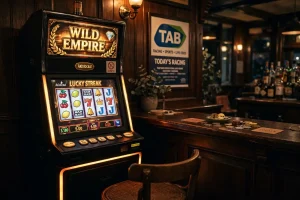
Plinko’s peg-and-token format can resemble pokies, but the label alone does not explain how a game is classified or operated.
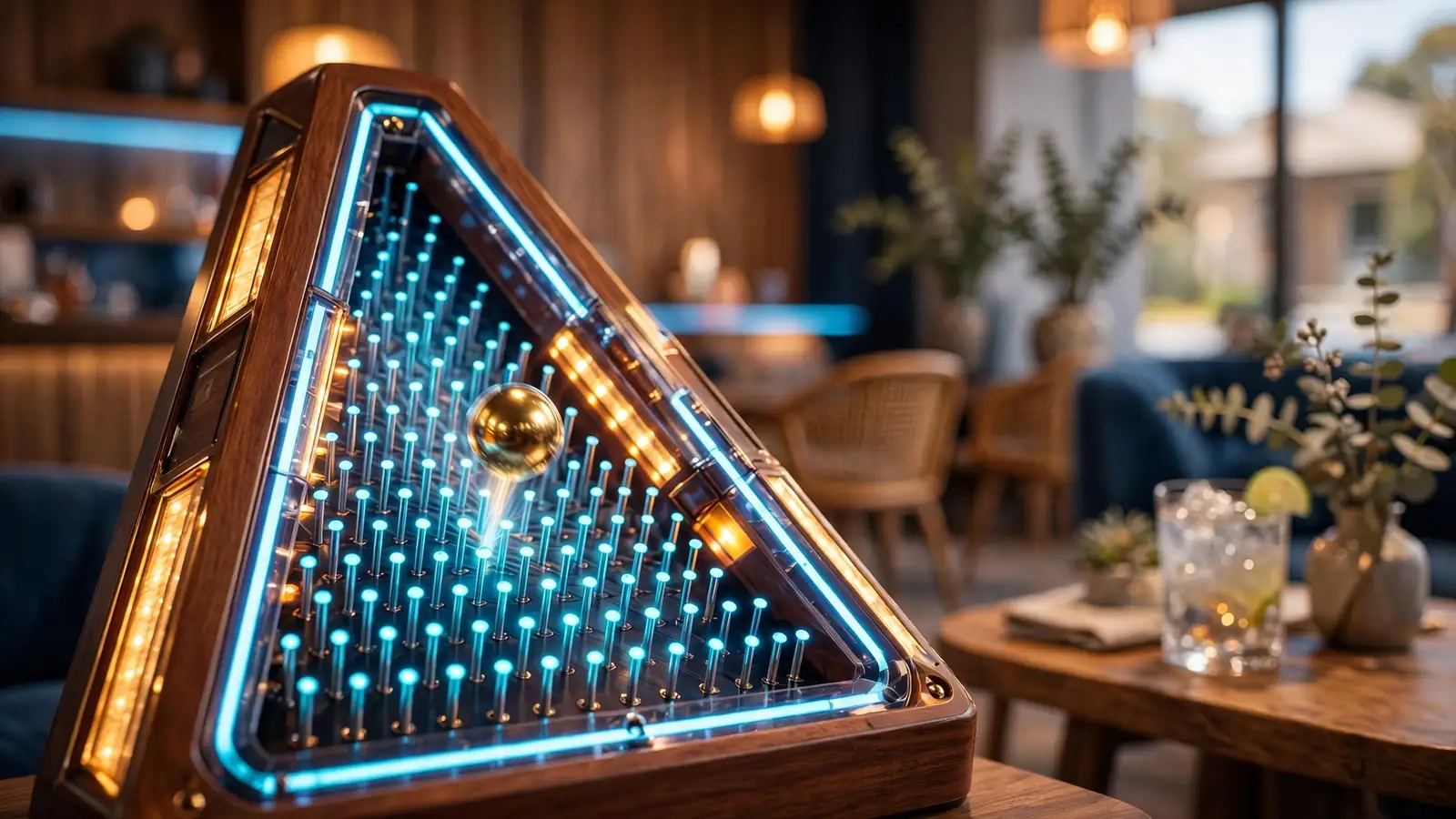
Plinko borrows a familiar visual idea: a token drops through a field of pegs, bounces from side to side and lands in a prize space. Online versions may wrap that simple path in bright lights, sound effects and a casino-style interface. That can make them feel close to pokies, even when the play is presented as a ball-drop game rather than spinning reels.
The resemblance matters, but it can also mislead. A Plinko-style game is not automatically a pokie just because it appears beside slot games or uses the same sort of flashy presentation. Nor does calling something a “Plinko slot” tell you much about how it works. The label might describe the look, the way a site groups its games, or simply the words used to sell it. I’ve learned not to treat a familiar wrapper as a reliable explanation.
That is worth keeping in mind when you encounter a Plinko game dressed up like a slot machine. The screen can make each round feel quick and self-contained: drop, bounce, result, repeat. But the visual simplicity does not make gambling harmless. A fast sequence can encourage you to keep going without much pause to think about what you have staked or lost. A few seconds of animation can conceal a very real money decision.
If you’re choosing a Plinko casino in Australia for 2026, use this list as a starting point and check the details that matter to you before playing.
Golden Pokies
You can note that Golden Pokies lists a Curacao licence.
Rollero Casino
You can check Rollero Casino’s stated licensing details: Curacao Gaming Control Board OGL/2023/176/0095, held by Hollycorn N.V.
Uptown Pokies
Uptown Pokies has operated since 2017 and lists a minimum deposit of A$20. You can also note its Curacao licensing.
SkyCrown
SkyCrown lists a Tobique Gaming Commission licence and a minimum deposit of A$30. Its stated payout times are around 10–15 minutes for crypto and 1–5 days for fiat.
Thor Casino
Thor Casino lists a Curacao licence through Antillephone N.V. (Versus Odds B.V.) and a minimum deposit of EUR 20.
SpinsUp
You can check SpinsUp’s stated licence: Curacao Gaming Control Board OGL/2023/174/0082, held by Dama N.V.
7Bit Casino
7Bit Casino is listed as operating under a Curacao licence and is operated by Dama N.V.
Roby Casino
Roby Casino lists Curacao eGaming licensing through Roby Games Ltd.
Lucky Dreams
Lucky Dreams lists a Curacao licence and a minimum deposit of A$20 using POLi.
House of Pokies
House of Pokies lists an international iGaming licence, though the source does not name the jurisdiction. You can also note its PayID payout time of 1–24 hours and minimum deposit of A$30, or A$10 for PayID.
The broader Australian context is not abstract. In reporting on Victorian poker-machine losses, gamble.com.au put the total at $2.6 billion over the year covered, more than $44.7 million above the figure for 2015. Those are reported losses, not a prediction about any individual player or a measure of what every person spends. Still, the scale is hard to brush off. It is a reminder that machine-style gambling can add up across a community, even when each individual session feels small.
The same reporting highlighted one venue in Melbourne’s north: the Epping Plaza Hotel was reported to have generated more than $21 million from 100 machines over the year discussed. That figure is about revenue from the machines, not a statement that every player lost the same amount. I find the distinction important. Big totals can sound distant, but they are built from people’s repeated decisions to put money in and keep playing.
None of this means a Plinko-style product has the same mechanics or financial pattern as a pub pokie. It does mean that a game borrowing the visual language of pokies deserves a clear-eyed look. The interface may make chance feel like a little skill test, especially when you watch a ball bounce close to a higher-value space. A near miss can look meaningful; it does not, by itself, tell you what will happen next. I’ve caught myself reading a pattern into randomness because the animation made it satisfying to do so. Not a strategy.
Australia’s debate about poker machines has included proposals aimed at limiting the size of bets. Senator Nick Xenophon and MP Andrew Wilkie put forward a plan for a one-dollar maximum bet on pokies. That was a proposal, not a description of a rule applying to all machines. Its place in the debate shows how concern about the pace and scale of machine gambling has led to calls for structural changes, rather than relying only on each player to exercise restraint.
For someone looking at an online Plinko product, the point is not to equate every format or assume the same risks in every session. It is to notice how design can make repeated wagering feel casual. A token falling through pegs can look more like a toy than a money game; a slot-like sound or prize display can make the stakes easier to forget. The entertainment framing does not erase the possibility of loss.
I would separate the two questions I used to lump together: “Does this look like a pokie?” and “What does playing it ask me to risk?” The first is about presentation. The second is about consequences. When the display is colourful and the rounds move quickly, the second question is the one worth slowing down for.
Pokies and other gambling products can cause serious harm, particularly for people who are vulnerable to gambling-related harm. If you are under 18, gambling is not for you. For adults, treating any machine-style game as entertainment rather than income is a basic safeguard; chasing losses can deepen the damage rather than repair it. A game’s name, animation or slot-like skin cannot promise a good outcome. The money at risk is still real.
Gambling Harm
Pokies and other gambling products can cause serious harm, particularly for vulnerable people. If you are under 18, gambling is not for you.
“Online casino” sounds like a straightforward description: a website where you can play casino-style games. For someone in Australia, though, the label can hide an important distinction. A site may display Plinko, call itself a casino and accept an Australian payment without being authorised to provide online casino services here.
I used to treat a familiar payment option as a kind of reassurance. If a site accepted money from my side of the world, I assumed it must have been set up for people here. That was a bad shortcut. A payment going through tells you something about the payment route; it does not establish that the operator is allowed to offer the service to Australians.
Offshore casinos often accept Australian payments while operating under licences issued elsewhere. That foreign licence is not an Australian authorisation. The site may be available on your screen, and its terms may mention a regulator in another country, but neither fact changes the rules that apply to a service offered to a person physically in Australia.
That distinction matters when the product is a Plinko game presented as part of a casino. Whether the page calls it a Plinko casino game, a live-casino option or a pokies-style title, the label does not create a separate legal category. The question is not simply whether the game has a page or whether an account can be opened. It is whether an operator may provide that kind of real-money online casino service to people in Australia.
Under the Interactive Gambling Act 2001, operators are prohibited from providing real-money online casino games to people located here. That includes casino-style products, rather than only games with traditional casino names. The legal restriction is directed at the service being offered; it is not a statement that every Australian who encounters an offshore site is committing an offence. Players are not criminalised simply for using an offshore site.
This is where the wording on a website can blur things. “Available in Australia” may mean the page loads, the site accepts Australian customers, or a payment method appears at checkout. Those are claims about access or the operator’s own practices. They are not the same as saying the service is legally authorised in Australia. A currency symbol or local payment option can make a site feel domestic without making its status domestic.
Nor does the word “licensed” settle the point on its own. It may refer to a licence from the place where the operator is based or regulated. That can tell you something about the operator’s claimed offshore framework, but it does not turn a prohibited service into one authorised for Australian customers. I have learned to read that word with the location attached. Licensed where? And authorised to offer what, to whom? Two different questions.
The same caution applies to variations such as “online Plinko casino” or “casino with Plinko”. They describe how a site presents its games, not the legal status of the service. A themed landing page, a live presentation or a pokies label cannot override the law. Search results and promotional copy may make the offer look ordinary; repetition is not proof of local approval.
Attention: An offshore licence or the ability to make a payment does not mean a service is legally authorised to provide real-money online casino games to people in Australia.
There is also a difference between being technically reachable and being legally permitted. Offshore gambling sites can accept payments from Australians, but access can be disrupted and enforcement can affect which pages remain available. So “I can open it” is not a reliable test of whether the service is authorised. It only tells you that the site was reachable at that moment.
I’m not writing this as a way to find a place to play. The practical point is narrower: don’t let a payment option, an offshore licence badge or a polished Australian-facing page stand in for local authorisation. Those details can explain how an offshore operator presents itself; they do not change the legal position for real-money online casino services in Australia.
If you are under eighteen, gambling is not an option. And even for adults, access should not be mistaken for safety or approval. Gambling can cause serious harm, particularly for people who are vulnerable to it. A bright game label is still just a label.
That distinction is easy to miss. It is worth keeping in view.
A balance on a screen can feel like money already in your hand. I used to read it that way. It isn’t. With real-money Plinko, the practical test comes when you ask to withdraw: the site may check who you are, whether the account details match, and whether your balance meets its cashout rules. A displayed amount is not the same as cash received.
For an Australian player, a site accepting Australian payments does not mean it is authorised to provide online casino games here. Real-money online casino services are prohibited when offered to people in Australia, even if an offshore site presents Plinko as an easy-to-access game. Keep that distinction in view before you put money in. Getting a payment through is not proof that the service is locally approved.
The first withdrawal is often where KYC becomes part of the process. Offshore sites commonly ask for identity documents such as a passport or driver’s licence, plus a utility bill. The purpose is to match the person requesting payment to the account and confirm the account details. It can feel like a surprise if you assumed verification would happen only when you registered.
I have learned not to treat “withdraw anytime” as a complete explanation. The terms may say that a payout request is subject to checks, and the site may ask for documents before it processes a first cashout. Read the requirements before staking money: which documents are accepted, whether images need to be clear, and whether the name and address on the account must match the documents. A mismatch can turn a simple request into a drawn-out exchange of messages.
That does not mean you should send sensitive documents casually. Check that you are using the site’s stated secure process, and do not share identity documents through an unsolicited message or an address you cannot verify. If the instructions are vague, pause rather than guessing. Once documents are in the wrong hands, fixing it is harder than waiting.
Offshore sites commonly set minimum withdrawal thresholds in the A$75–A$150 range. That means a small balance may not be eligible for a cashout yet, even if the account shows winnings. The exact threshold depends on the site’s terms, so check the figure that applies before you deposit or play.
Offshore sites commonly set minimum withdrawal thresholds in the A$75–A$150 range, meaning balances below this amount may not be eligible for cashout.
This is where I used to make a bad calculation: I looked at the amount I hoped to withdraw, not the amount the rules required me to request. If a site sets a minimum, a balance below it may remain in the account until it reaches the threshold. That is not the same as a promise that you will be able to reach it, or that a later request will be approved automatically. A minimum is a condition, not a payout guarantee.
Look for any other cashout conditions in the same section of the terms. Make sure you understand the available withdrawal methods and whether the site requires the method to match the one used to fund the account. Don’t assume the deposit screen explains the withdrawal process. It often does not.
When I now assess a real-money offer, I separate three things: the balance displayed, the amount currently eligible to withdraw, and the amount that has actually arrived. They are not interchangeable. An account can show funds while a document check is pending or while the balance remains below a withdrawal threshold. The only amount you can treat as received is the amount that reaches your payment account.
Keep copies of the relevant terms and records of your deposits, requests and messages. If a site changes what it asks for, a clear record helps you understand what happened. Still, paperwork cannot remove the underlying risk of using an offshore casino service, and it does not make the service locally authorised.
Real money changes the feel of a Plinko game quickly. It can make each drop seem like a small decision, while the total exposure creeps up unnoticed. Set a firm amount you can afford to lose and stop when it is gone; don’t add more to recover a loss or treat a balance on screen as income. Gambling can cause serious harm, particularly for people who are vulnerable. If the process starts affecting bills, sleep or relationships, step away and seek support. The payout screen is not worth the cost.
A Plinko-style casino game and a progressive pokie can both show a possible prize, but that does not make them the same kind of game. The useful distinction is where the prize comes from and what has to happen for it to be won.
In a Plinko game, a ball is released onto a board and bounces through pegs towards a slot or other marked landing area. The result is tied to where the ball finishes and the payout attached to that outcome. The game may present several possible prizes, but that alone does not mean they are pooled across players or growing as other people play. A prize shown on the screen is not automatically a progressive jackpot.
A progressive jackpot works differently. Play on linked pokies contributes to a shared prize pool, which can grow as people use those machines or the network they belong to. The jackpot is a separate feature from the ordinary payouts of the pokie: the main game can have its own results while the progressive prize builds in the background. That can make the displayed amount move, but it does not tell you how likely you are to win it.
There are two broad arrangements: standalone progressive jackpots tied to a local machine or small setup, and networked jackpots that link many machines or an operator's entire fleet.
There are two broad arrangements. A standalone progressive jackpot is tied to a local machine or small machine-level setup. A networked jackpot links many machines, or may span an online operator’s fleet. In either case, linked play feeds the jackpot; the scale of the pool depends on the arrangement. The word “networked” describes the connection, not a better chance for any one player.
That distinction matters when a Plinko screen uses jackpot language. I’ve learned not to treat a large number or dramatic animation as an explanation. Check whether the game’s rules actually say that wagers contribute to a shared progressive pool, or whether the displayed prize is simply one of the outcomes in that individual game. If the rules do not explain the connection, do not assume one.
A progressive jackpot may have conditions separate from the basic game. Two worth checking are the contribution rate and the minimum bet needed to qualify. The contribution rate describes how a portion of play is allocated to the jackpot; the rules should explain how it applies. The minimum bet determines whether a particular wager is eligible at all.
A specialist review gives A$1.00 as an example of a minimum bet that can be required for jackpot eligibility. That is an example, not a universal threshold. The conditions can vary between games, so a smaller wager might still play the base game without qualifying for its progressive prize. Check the game’s own rules before treating a jackpot display as something your bet can win.
Also look for what the rules say about the jackpot trigger and eligible play. A progressive amount can rise while players use linked machines, but that growth does not mean every bet qualifies, or that a jackpot is due soon. I used to read a rising total as a kind of promise. It isn’t.
A casino game of Plinko may have its own payout structure and risks, while a progressive pokie adds a linked jackpot feature. Neither format is automatically more favourable: the relevant mechanics and conditions are different, and a headline prize does not settle the question. If you are 18 or older and choose to gamble, keep the distinction clear and do not treat either format as a way to make income. Gambling can cause serious harm, particularly for vulnerable people. The label is not the mechanics.
I used to read a review’s headline, spot a confident percentage and assume somebody had checked the important bit for me. That was lazy. A review can be useful, but only if you separate what it actually verifies from what it merely repeats.
Start with the game being discussed. “Plinko” can describe a style of game, while names such as Plinko Rush, Plinko Verde or Plinko Deluxe may refer to particular titles or versions. A review should identify the exact game and, where available, its provider. If it slides between different names without explaining whether they are the same product, treat its conclusions carefully. The label alone tells you little.
RTP is one claim worth checking, but it is not a forecast of what you will get back. It describes a theoretical return over extensive play, not the result of one session or a promise about your own balance. For a concrete comparison, KA Gaming slot RTP percentages typically fall between 94% and 96%. That is a range for its slots; it should not be pasted onto a Plinko game unless the review identifies that game’s own published RTP. Similar-looking gameplay is not evidence of identical maths.
I look for the review to show where a figure came from and what it applies to. Is it quoting information attached to the specific game, or repeating a general claim about a provider? Does it distinguish RTP from volatility or from the possibility of a large individual win? If those ideas are blurred together, the number may sound more meaningful than it is.
The same applies to polished labels. A “free” version, a celebrity association such as MrBeast, or a title that sounds familiar does not by itself verify who made the game or how it works. Nor does a page become independent just because it calls itself a review. Look for clear descriptions and claims that can be checked, rather than a pile of praise.
When I read a Plinko casino review now, I ask a plain question: what would I be able to confirm from the game itself, and what is just the reviewer’s wording? That small pause has saved me from treating a neat paragraph as evidence. A percentage can inform you. It cannot promise an outcome.
When I look up an online Plinko game from Australia, I keep two things separate: what a website says it offers and what operators are allowed to provide here. A page being visible, or accepting Australian visitors, does not make its casino games lawful to offer locally.
The Interactive Gambling Act 2001 prohibits operators from providing real-money online casino games to people in Australia. That covers casino-style games such as slots, poker, blackjack and roulette; a Plinko game offered as a real-money casino product sits within that context. The restriction is aimed at the service provider, not at making an individual player a criminal for using an offshore site.
ACMA—the Australian Communications and Media Authority—is the federal regulator that enforces the Act and monitors compliance with interactive gambling laws. It can ask Australian internet providers to block websites that provide prohibited services or advertise them here. So a site disappearing from a browser is not necessarily a technical glitch or a sign that its operator has changed its terms. It may reflect an enforcement action.
The scale of that work is measurable. ACMA says it has blocked more than 1,455 illegal gambling and affiliate websites since enforcement actions began in November 2019. On services leaving the market since 2017, published figures disagree: one account puts the number above 210, while another reports more than 190. The difference matters; it is better to acknowledge competing totals than turn one into a definitive count.
Blocking is not a guarantee that every prohibited service becomes unreachable at once. It is one enforcement tool, and the regulator’s actions can affect both gambling sites and affiliate pages promoting them. A polished page, a familiar game name or a working payment option still tells you nothing by itself about whether the service is permitted to operate for Australians.
That distinction is easy to miss when a game is presented as casual entertainment. I have done it myself: I treated an accessible page as if access meant approval. It doesn’t. And gambling can cause serious harm, particularly for vulnerable people, so the legal line is only one reason to pause before treating a casino-style game as harmless.
“Free play” can describe a demo round with no cash stake, but the label does not tell you everything about what is being offered. It may mean a version you can try without depositing, or it may refer to promotional credit or free spins attached to an account. Those are not the same thing.
In a demo, the balance is only part of the display. A result may show how a Plinko-style game behaves, but it is not money you can withdraw. I used to see a pretend balance climb and feel as if I had learned something about what a real session might bring. I hadn’t. The demo had removed the part that mattered most to my decisions: having my own money at stake.
A “free spin” can be more complicated. If it comes with bonus funds, the winnings may be subject to conditions before they can be withdrawn. The wording on the offer should say whether the credit is withdrawable, which games count, and what conditions apply. If those details are hard to find, the word “free” is doing more work than it should.
One specialist review describes bonus wagering requirements in the range of 30–50 times the bonus amount. That is an example of a claim to verify against the specific offer, not a rule that applies everywhere. Bonus funds are not cash in your account, and a displayed win does not by itself mean you can take that amount out.
A free Plinko demo can help you understand the interface or see how a round unfolds. It cannot show what it feels like to lose money, and it cannot turn a promotional balance into guaranteed cash. Keep those lines separate. No shortcut.
Free-to-play wording also does not change the rules around real-money online casino services in Australia. If you gamble, you must be at least 18, and gambling can cause serious harm to vulnerable people.
Crypto can make a Plinko withdrawal sound simple: send the coins, receive the coins. I used to read “fast” as meaning the amount shown on the withdrawal screen would land intact. That is not what the wording promises.
A specialist review reports that crypto withdrawals can clear faster than other payment methods, but network fees and conversion spreads can cut into the amount received. Those are separate deductions. A network fee is charged for processing a transaction on the blockchain; a conversion spread is the difference between the rate used to convert one currency or asset into another and the rate you might expect from a headline market price. The exact effect depends on the transaction and the terms being applied.
So if you are looking at crypto payments for a Plinko casino, compare the displayed withdrawal amount with the amount you would actually receive after any stated charges and conversion. “No waiting” is not the same as “no cost.” And a quick clearance does not tell you whether the conversion rate is favourable.
I have learned to treat the final figure as the useful one, not the reassuring word beside the payment button. Check which asset the site says it will send, whether it converts the balance before sending, and which fees or exchange rates apply. If those details are hard to find, you cannot confidently estimate the net amount in advance. That uncertainty matters more than a speed claim.
Attention: Network fees and conversion spreads can reduce the final amount of a crypto withdrawal; "fast" clearance does not mean "no cost."
The same caution applies when a page labels itself a crypto casino or promotes Plinko with crypto: the label says little about the amount that arrives. A “script” is not a payment promise either; it does not explain network charges or conversion terms. Keep the calculation focused on what leaves the account and what reaches your wallet, rather than assuming those figures match.
Quick is not free.
“Free” can describe how a bonus is offered; it does not mean the resulting balance is cash you can withdraw straight away. Bonus-derived winnings may stay locked behind wagering conditions. I used to focus on the headline amount and skim the small print. That was backwards.
The useful first step is to turn the requirement into a betting total. A specialist review gives this worked example: a $100 bonus with a 40x wagering requirement calls for $4,000 in qualifying bets before bonus-derived winnings can be withdrawn. That is the amount wagered across eligible play, not a bill for $4,000 and not a promise you will win it back. Repeated bets can build that total while your balance moves in either direction.
Then check what counts. The multiplier alone does not tell you whether every game contributes equally, or whether a particular game is excluded. One specialist review says blackjack can count for only 10% towards wagering. On terms like those, a bet may add only a fraction of its value to the qualifying total. Read the contribution table for the specific offer rather than assuming a Plinko round, or any other game, clears the requirement at face value.
A no-deposit label does not remove these conditions. Nor does a themed offer—whether it mentions Plinko or another game—make bonus funds immediately withdrawable. The terms determine which funds are restricted, what play qualifies and when the restriction ends. If those details are hard to find, that is a reason to pause, not to treat the advertised balance as money in your pocket.
I now do the multiplication before I get distracted by the bonus figure. It is a plain check, but it changes how large the offer feels. Bonus money is conditional. Keep it separate from cash you can actually use or withdraw.
“Guru” sounds like someone has done the homework for you. “Lucky” sounds like a game might be due to pay. I’ve fallen for that sort of wording before; it can make a name feel like evidence when it is only a name.
If a Plinko page is presented as a guru’s pick, look for something you can actually verify: what the claim is based on, whether the explanation is clear, and whether it separates fact from sales language. A confident tone is not proof of expertise. Nor does a label such as “lucky” tell you anything dependable about what will happen in a particular round.
I also used to assume that a page aimed at another country might still be a useful shortcut. It isn’t automatically relevant here. A UK-facing description does not establish that a service is authorised for Australians or that it can be accessed from Australia. ACMA actively blocks offshore gambling sites, so a familiar name or polished page is no guarantee of reliable access.
That distinction matters when you see words like “best”, “trusted” or “expert”. Treat each as a claim to inspect, not a reason to hand over money. If the page gives no basis for its language, you have learned something: the wording is doing the work, not evidence.
I now try to read the plain details before I let a catchy name set my expectations. If those details are hard to find, I stop there. No magic in a label. Keep gambling to adults aged 18 or older, and remember that gambling can cause serious harm, particularly for people who are vulnerable.